Interplane page as plain text, for reading tools and agents. English is the reference text: translate it with your own tool. Text in backticks and in ``` blocks (commands, fingerprints, file names) and link targets in <...> are exact: copy them, never translate them.
Page: /drakestapleton/aienux/blob/main/vendor/itoa/src/lib.rs
# aienux
Aienux, the AienOS kernel: boot, scheduling, IPC and capability boundaries. Pre-alpha; host, emulator and physical evidence are labelled separately.
Brought by drakestapleton
Sign in to star 0 stars 0 watching
About Files History Releases Proposed changes Issues For developers
branch `main` Branches Tags History
`aienux / vendor / itoa / src / lib.rs`
466 lines · 16904 bytes Raw Blame History
1 //! [![github]](https://github.com/dtolnay/itoa) [![crates-io]](https://crates.io/crates/itoa) [![docs-rs]](https://docs.rs/itoa)
2 //!
3 //! [github]: https://img.shields.io/badge/github-8da0cb?style=for-the-badge&labelColor=555555&logo=github
4 //! [crates-io]: https://img.shields.io/badge/crates.io-fc8d62?style=for-the-badge&labelColor=555555&logo=rust
5 //! [docs-rs]: https://img.shields.io/badge/docs.rs-66c2a5?style=for-the-badge&labelColor=555555&logo=docs.rs
6 //!
7 //!
8 //!
9 //! This crate provides a fast conversion of integer primitives to decimal
10 //! strings. The implementation comes straight from [libcore] but avoids the
11 //! performance penalty of going through [`core::fmt::Formatter`].
12 //!
13 //! See also [`zmij`] for printing floating point primitives.
14 //!
15 //! [libcore]: https://github.com/rust-lang/rust/blob/1.92.0/library/core/src/fmt/num.rs#L190-L253
16 //! [`zmij`]: https://github.com/dtolnay/zmij
17 //!
18 //! # Example
19 //!
20 //! ```
21 //! fn main() {
22 //! let mut buffer = itoa::Buffer::new();
23 //! let printed = buffer.format(128u64);
24 //! assert_eq!(printed, "128");
25 //! }
26 //! ```
27 //!
28 //! # Performance
29 //!
30 //! The [itoa-benchmark] compares this library and other Rust integer formatting
31 //! implementations across a range of integer sizes. The vertical axis in this
32 //! chart shows nanoseconds taken by a single execution of
33 //! `itoa::Buffer::new().format(value)` so a lower result indicates a faster
34 //! library.
35 //!
36 //! [itoa-benchmark]: https://github.com/dtolnay/itoa-benchmark
37 //!
38 //! 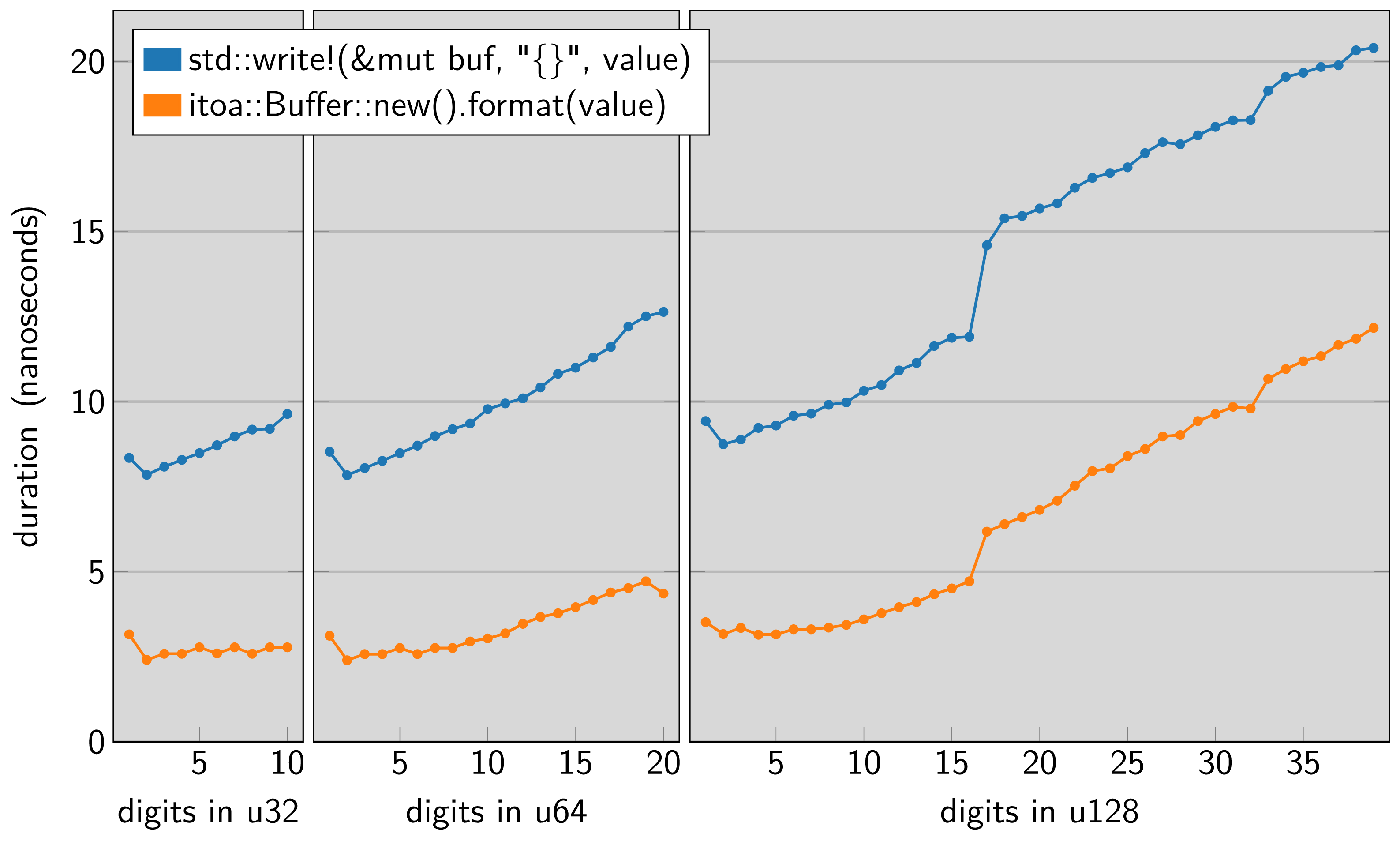
39
40 #![doc(html_root_url = "https://docs.rs/itoa/1.0.18")]
41 #![no_std]
42 #![allow(
43 clippy::cast_lossless,
44 clippy::cast_possible_truncation,
45 clippy::cast_sign_loss,
46 clippy::expl_impl_clone_on_copy,
47 clippy::identity_op,
48 clippy::items_after_statements,
49 clippy::must_use_candidate,
50 clippy::needless_doctest_main,
51 clippy::unreadable_literal
52 )]
53
54 mod u128_ext;
55
56 use core::hint;
57 use core::mem::{self, MaybeUninit};
58 use core::str;
59 #[cfg(feature = "no-panic")]
60 use no_panic::no_panic;
61
62 /// A correctly sized stack allocation for the formatted integer to be written
63 /// into.
64 ///
65 /// # Example
66 ///
67 /// ```
68 /// let mut buffer = itoa::Buffer::new();
69 /// let printed = buffer.format(1234);
70 /// assert_eq!(printed, "1234");
71 /// ```
72 pub struct Buffer {
73 bytes: [MaybeUninit; i128::MAX_STR_LEN],
74 }
75
76 impl Default for Buffer {
77 #[inline]
78 fn default() -> Buffer {
79 Buffer::new()
80 }
81 }
82
83 impl Copy for Buffer {}
84
85 #[allow(clippy::non_canonical_clone_impl)]
86 impl Clone for Buffer {
87 #[inline]
88 fn clone(&self) -> Self {
89 Buffer::new()
90 }
91 }
92
93 impl Buffer {
94 /// This is a cheap operation; you don't need to worry about reusing buffers
95 /// for efficiency.
96 #[inline]
97 #[cfg_attr(feature = "no-panic", no_panic)]
98 pub fn new() -> Buffer {
99 let bytes = [MaybeUninit::::uninit(); i128::MAX_STR_LEN];
100 Buffer { bytes }
101 }
102
103 /// Print an integer into this buffer and return a reference to its string
104 /// representation within the buffer.
105 #[cfg_attr(feature = "no-panic", no_panic)]
106 pub fn format(&mut self, i: I) -> &str {
107 let buf_ptr = self.bytes.as_mut_ptr().cast::();
108 let string = i.write(unsafe { &mut *buf_ptr });
109 if string.len() > I::MAX_STR_LEN {
110 unsafe { hint::unreachable_unchecked() };
111 }
112 string
113 }
114 }
115
116 /// An integer that can be written into an [`itoa::Buffer`][Buffer].
117 ///
118 /// This trait is sealed and cannot be implemented for types outside of itoa.
119 pub trait Integer: private::Sealed {
120 /// The maximum length of string that formatting an integer of this type can
121 /// produce on the current target platform.
122 const MAX_STR_LEN: usize;
123 }
124
125 // Seal to prevent downstream implementations of the Integer trait.
126 mod private {
127 #[doc(hidden)]
128 pub trait Sealed: Copy {
129 #[doc(hidden)]
130 type Buffer: 'static;
131 fn write(self, buf: &mut Self::Buffer) -> &str;
132 }
133 }
134
135 macro_rules! impl_Integer {
136 ($Signed:ident, $Unsigned:ident) => {
137 const _: () = {
138 assert!($Signed::MIN < 0, "need signed");
139 assert!($Unsigned::MIN == 0, "need unsigned");
140 assert!($Signed::BITS == $Unsigned::BITS, "need counterparts");
141 };
142
143 impl Integer for $Unsigned {
144 const MAX_STR_LEN: usize = $Unsigned::MAX.ilog10() as usize + 1;
145 }
146
147 impl private::Sealed for $Unsigned {
148 type Buffer = [MaybeUninit; Self::MAX_STR_LEN];
149
150 #[inline]
151 #[cfg_attr(feature = "no-panic", no_panic)]
152 fn write(self, buf: &mut Self::Buffer) -> &str {
153 let offset = Unsigned::fmt(self, buf);
154 // SAFETY: Starting from `offset`, all elements of the slice have been set.
155 unsafe { slice_buffer_to_str(buf, offset) }
156 }
157 }
158
159 impl Integer for $Signed {
160 const MAX_STR_LEN: usize = $Signed::MAX.ilog10() as usize + 2;
161 }
162
163 impl private::Sealed for $Signed {
164 type Buffer = [MaybeUninit; Self::MAX_STR_LEN];
165
166 #[inline]
167 #[cfg_attr(feature = "no-panic", no_panic)]
168 fn write(self, buf: &mut Self::Buffer) -> &str {
169 let mut offset = Self::MAX_STR_LEN - $Unsigned::MAX_STR_LEN;
170 offset += Unsigned::fmt(
171 self.unsigned_abs(),
172 (&mut buf[offset..]).try_into().unwrap(),
173 );
174 if self < 0 {
175 offset -= 1;
176 buf[offset].write(b'-');
177 }
178 // SAFETY: Starting from `offset`, all elements of the slice have been set.
179 unsafe { slice_buffer_to_str(buf, offset) }
180 }
181 }
182 };
183 }
184
185 impl_Integer!(i8, u8);
186 impl_Integer!(i16, u16);
187 impl_Integer!(i32, u32);
188 impl_Integer!(i64, u64);
189 impl_Integer!(i128, u128);
190
191 macro_rules! impl_Integer_size {
192 ($t:ty as $primitive:ident #[cfg(target_pointer_width = $width:literal)]) => {
193 #[cfg(target_pointer_width = $width)]
194 impl Integer for $t {
195 const MAX_STR_LEN: usize = <$primitive as Integer>::MAX_STR_LEN;
196 }
197
198 #[cfg(target_pointer_width = $width)]
199 impl private::Sealed for $t {
200 type Buffer = <$primitive as private::Sealed>::Buffer;
201
202 #[inline]
203 #[cfg_attr(feature = "no-panic", no_panic)]
204 fn write(self, buf: &mut Self::Buffer) -> &str {
205 (self as $primitive).write(buf)
206 }
207 }
208 };
209 }
210
211 impl_Integer_size!(isize as i16 #[cfg(target_pointer_width = "16")]);
212 impl_Integer_size!(usize as u16 #[cfg(target_pointer_width = "16")]);
213 impl_Integer_size!(isize as i32 #[cfg(target_pointer_width = "32")]);
214 impl_Integer_size!(usize as u32 #[cfg(target_pointer_width = "32")]);
215 impl_Integer_size!(isize as i64 #[cfg(target_pointer_width = "64")]);
216 impl_Integer_size!(usize as u64 #[cfg(target_pointer_width = "64")]);
217
218 #[repr(C, align(2))]
219 struct DecimalPairs([u8; 200]);
220
221 // The string of all two-digit numbers in range 00..99 is used as a lookup table.
222 static DECIMAL_PAIRS: DecimalPairs = DecimalPairs(
223 *b"`0001020304050607080910111213141516171819`\
224 `2021222324252627282930313233343536373839`\
225 `4041424344454647484950515253545556575859`\
226 `6061626364656667686970717273747576777879`\
227 `8081828384858687888990919293949596979899`",
228 );
229
230 // Returns {value / 100, value % 100} correct for values of up to 4 digits.
231 fn divmod100(value: u32) -> (u32, u32) {
232 debug_assert!(value < 10_000);
233 const EXP: u32 = 19; // 19 is faster or equal to 12 even for 3 digits.
234 const SIG: u32 = (1 << EXP) / 100 + 1;
235 let div = (value * SIG) >> EXP; // value / 100
236 (div, value - div * 100)
237 }
238
239 /// This function converts a slice of ascii characters into a `&str` starting
240 /// from `offset`.
241 ///
242 /// # Safety
243 ///
244 /// `buf` content starting from `offset` index MUST BE initialized and MUST BE
245 /// ascii characters.
246 #[cfg_attr(feature = "no-panic", no_panic)]
247 unsafe fn slice_buffer_to_str(buf: &[MaybeUninit], offset: usize) -> &str {
248 // SAFETY: `offset` is always included between 0 and `buf`'s length.
249 let written = unsafe { buf.get_unchecked(offset..) };
250 // SAFETY: (`assume_init_ref`) All buf content since offset is set.
251 // SAFETY: (`from_utf8_unchecked`) Writes use ASCII from the lookup table exclusively.
252 unsafe { str::from_utf8_unchecked(&*(written as *const [MaybeUninit] as *const [u8])) }
253 }
254
255 trait Unsigned: Integer {
256 fn fmt(self, buf: &mut Self::Buffer) -> usize;
257 }
258
259 macro_rules! impl_Unsigned {
260 ($Unsigned:ident) => {
261 impl Unsigned for $Unsigned {
262 #[cfg_attr(feature = "no-panic", no_panic)]
263 fn fmt(self, buf: &mut Self::Buffer) -> usize {
264 // Count the number of bytes in buf that are not initialized.
265 let mut offset = buf.len();
266 // Consume the least-significant decimals from a working copy.
267 let mut remain = self;
268
269 // Format per four digits from the lookup table.
270 // Four digits need a 16-bit $Unsigned or wider.
271 while mem::size_of::() > 1
272 && remain
273 > 999
274 .try_into()
275 .expect("branch is not hit for types that cannot fit 999 (u8)")
276 {
277 offset -= 4;
278
279 // pull two pairs
280 let scale: Self = 1_00_00
281 .try_into()
282 .expect("branch is not hit for types that cannot fit 1E4 (u8)");
283 let quad = remain % scale;
284 remain /= scale;
285 let (pair1, pair2) = divmod100(quad as u32);
286 unsafe {
287 buf[offset + 0]
288 .write(*DECIMAL_PAIRS.0.get_unchecked(pair1 as usize * 2 + 0));
289 buf[offset + 1]
290 .write(*DECIMAL_PAIRS.0.get_unchecked(pair1 as usize * 2 + 1));
291 buf[offset + 2]
292 .write(*DECIMAL_PAIRS.0.get_unchecked(pair2 as usize * 2 + 0));
293 buf[offset + 3]
294 .write(*DECIMAL_PAIRS.0.get_unchecked(pair2 as usize * 2 + 1));
295 }
296 }
297
298 // Format per two digits from the lookup table.
299 if remain > 9 {
300 offset -= 2;
301
302 let (last, pair) = divmod100(remain as u32);
303 remain = last as Self;
304 unsafe {
305 buf[offset + 0]
306 .write(*DECIMAL_PAIRS.0.get_unchecked(pair as usize * 2 + 0));
307 buf[offset + 1]
308 .write(*DECIMAL_PAIRS.0.get_unchecked(pair as usize * 2 + 1));
309 }
310 }
311
312 // Format the last remaining digit, if any.
313 if remain != 0 || self == 0 {
314 offset -= 1;
315
316 // Either the compiler sees that remain < 10, or it prevents
317 // a boundary check up next.
318 let last = remain as u8 & 15;
319 buf[offset].write(b'0' + last);
320 // not used: remain = 0;
321 }
322
323 offset
324 }
325 }
326 };
327 }
328
329 impl_Unsigned!(u8);
330 impl_Unsigned!(u16);
331 impl_Unsigned!(u32);
332 impl_Unsigned!(u64);
333
334 impl Unsigned for u128 {
335 #[cfg_attr(feature = "no-panic", no_panic)]
336 fn fmt(self, buf: &mut Self::Buffer) -> usize {
337 // Optimize common-case zero, which would also need special treatment due to
338 // its "leading" zero.
339 if self == 0 {
340 let offset = buf.len() - 1;
341 buf[offset].write(b'0');
342 return offset;
343 }
344 // Take the 16 least-significant decimals.
345 let (quot_1e16, mod_1e16) = div_rem_1e16(self);
346 let (mut remain, mut offset) = if quot_1e16 == 0 {
347 (mod_1e16, u128::MAX_STR_LEN)
348 } else {
349 // Write digits at buf[23..39].
350 enc_16lsd::<{ u128::MAX_STR_LEN - 16 }>(buf, mod_1e16);
351
352 // Take another 16 decimals.
353 let (quot2, mod2) = div_rem_1e16(quot_1e16);
354 if quot2 == 0 {
355 (mod2, u128::MAX_STR_LEN - 16)
356 } else {
357 // Write digits at buf[7..23].
358 enc_16lsd::<{ u128::MAX_STR_LEN - 32 }>(buf, mod2);
359 // Quot2 has at most 7 decimals remaining after two 1e16 divisions.
360 (quot2 as u64, u128::MAX_STR_LEN - 32)
361 }
362 };
363
364 // Format per four digits from the lookup table.
365 while remain > 999 {
366 offset -= 4;
367
368 // pull two pairs
369 let quad = remain % 1_00_00;
370 remain /= 1_00_00;
371 let (pair1, pair2) = divmod100(quad as u32);
372 unsafe {
373 buf[offset + 0].write(*DECIMAL_PAIRS.0.get_unchecked(pair1 as usize * 2 + 0));
374 buf[offset + 1].write(*DECIMAL_PAIRS.0.get_unchecked(pair1 as usize * 2 + 1));
375 buf[offset + 2].write(*DECIMAL_PAIRS.0.get_unchecked(pair2 as usize * 2 + 0));
376 buf[offset + 3].write(*DECIMAL_PAIRS.0.get_unchecked(pair2 as usize * 2 + 1));
377 }
378 }
379
380 // Format per two digits from the lookup table.
381 if remain > 9 {
382 offset -= 2;
383
384 let (last, pair) = divmod100(remain as u32);
385 remain = last as u64;
386 unsafe {
387 buf[offset + 0].write(*DECIMAL_PAIRS.0.get_unchecked(pair as usize * 2 + 0));
388 buf[offset + 1].write(*DECIMAL_PAIRS.0.get_unchecked(pair as usize * 2 + 1));
389 }
390 }
391
392 // Format the last remaining digit, if any.
393 if remain != 0 {
394 offset -= 1;
395
396 // Either the compiler sees that remain < 10, or it prevents
397 // a boundary check up next.
398 let last = remain as u8 & 15;
399 buf[offset].write(b'0' + last);
400 // not used: remain = 0;
401 }
402 offset
403 }
404 }
405
406 // Encodes the 16 least-significant decimals of n into `buf[OFFSET..OFFSET + 16]`.
407 #[cfg_attr(feature = "no-panic", no_panic)]
408 fn enc_16lsd(buf: &mut [MaybeUninit], n: u64) {
409 // Consume the least-significant decimals from a working copy.
410 let mut remain = n;
411
412 // Format per four digits from the lookup table.
413 for quad_index in (1..4).rev() {
414 // pull two pairs
415 let quad = remain % 1_00_00;
416 remain /= 1_00_00;
417 let (pair1, pair2) = divmod100(quad as u32);
418 unsafe {
419 buf[quad_index * 4 + OFFSET + 0]
420 .write(*DECIMAL_PAIRS.0.get_unchecked(pair1 as usize * 2 + 0));
421 buf[quad_index * 4 + OFFSET + 1]
422 .write(*DECIMAL_PAIRS.0.get_unchecked(pair1 as usize * 2 + 1));
423 buf[quad_index * 4 + OFFSET + 2]
424 .write(*DECIMAL_PAIRS.0.get_unchecked(pair2 as usize * 2 + 0));
425 buf[quad_index * 4 + OFFSET + 3]
426 .write(*DECIMAL_PAIRS.0.get_unchecked(pair2 as usize * 2 + 1));
427 }
428 }
429
430 // final two pairs
431 let (pair1, pair2) = divmod100(remain as u32);
432 unsafe {
433 buf[OFFSET + 0].write(*DECIMAL_PAIRS.0.get_unchecked(pair1 as usize * 2 + 0));
434 buf[OFFSET + 1].write(*DECIMAL_PAIRS.0.get_unchecked(pair1 as usize * 2 + 1));
435 buf[OFFSET + 2].write(*DECIMAL_PAIRS.0.get_unchecked(pair2 as usize * 2 + 0));
436 buf[OFFSET + 3].write(*DECIMAL_PAIRS.0.get_unchecked(pair2 as usize * 2 + 1));
437 }
438 }
439
440 // Euclidean division plus remainder with constant 1E16 basically consumes 16
441 // decimals from n.
442 //
443 // The integer division algorithm is based on the following paper:
444 //
445 // T. Granlund and P. Montgomery, “Division by Invariant Integers Using Multiplication”
446 // in Proc. of the SIGPLAN94 Conference on Programming Language Design and
447 // Implementation, 1994, pp. 61–72
448 //
449 #[cfg_attr(feature = "no-panic", no_panic)]
450 fn div_rem_1e16(n: u128) -> (u128, u64) {
451 const D: u128 = 1_0000_0000_0000_0000;
452 // The check inlines well with the caller flow.
453 if n < D {
454 return (0, n as u64);
455 }
456
457 // These constant values are computed with the CHOOSE_MULTIPLIER procedure
458 // from the Granlund & Montgomery paper, using N=128, prec=128 and d=1E16.
459 const M_HIGH: u128 = `76624777043294442917917351357515459181`;
460 const SH_POST: u8 = 51;
461
462 // n.widening_mul(M_HIGH).1 >> SH_POST
463 let quot = u128_ext::mulhi(n, M_HIGH) >> SH_POST;
464 let rem = n - quot * D;
465 (quot, rem as u64)
466 }