Interplane page as plain text, for reading tools and agents. English is the reference text: translate it with your own tool. Text in backticks and in ``` blocks (commands, fingerprints, file names) and link targets in <...> are exact: copy them, never translate them.
Page: /drakestapleton/omega-tool-model/blob/main/deployment/conversation/model-card.md
# omega-tool-model
First-party Omega tool-use model source, serving harnesses, and verification records
Brought by drakestapleton
Sign in to star 0 stars 0 watching
About Files History Releases Proposed changes Issues For developers
branch `main` Branches Tags History
`omega-tool-model / deployment / conversation / model-card.md`
256 lines · 11953 bytes Raw Blame History Rendered
1 ---
2 library_name: transformers
3 license: apache-2.0
4 license_link: https://huggingface.co/Qwen/Qwen3-30B-A3B-Instruct-2507/blob/main/LICENSE
5 base_model:
6 - Qwen/Qwen3-30B-A3B-Instruct-2507
7 tags:
8 - qwen
9 - qwen3
10 - unsloth
11 ---
12
13
14 See our collection for all versions of Qwen3 including GGUF, 4-bit & 16-bit formats.
15
16
17 Learn to run Qwen3-2507 correctly - Read our Guide.
18
19
20 Unsloth Dynamic 2.0 achieves superior accuracy & outperforms other leading quants.
21
22
33
✨ Read our Qwen3-2507 Guide here!
34
35
36 - Fine-tune Qwen3 (14B) for free using our Google [Colab notebook here](https://docs.unsloth.ai/get-started/unsloth-notebooks)!
37 - Read our Blog about Qwen3 support: [unsloth.ai/blog/qwen3](https://unsloth.ai/blog/qwen3)
38 - View the rest of our notebooks in our [docs here](https://docs.unsloth.ai/get-started/unsloth-notebooks).
39 - Run & export your fine-tuned model to Ollama, llama.cpp or HF.
40
41 | Unsloth supports | Free Notebooks | Performance | Memory use |
42 |-----------------|--------------------------------------------------------------------------------------------------------------------------|-------------|----------|
43 | **Qwen3 (14B)** | [▶️ Start on Colab](https://docs.unsloth.ai/get-started/unsloth-notebooks) | 3x faster | 70% less |
44 | **GRPO with Qwen3 (8B)** | [▶️ Start on Colab](https://docs.unsloth.ai/get-started/unsloth-notebooks) | 3x faster | 80% less |
45 | **Llama-3.2 (3B)** | [▶️ Start on Colab](https://colab.research.google.com/github/unslothai/notebooks/blob/main/nb/Llama3.2_(1B_and_3B)-Conversational.ipynb) | 2.4x faster | 58% less |
46 | **Llama-3.2 (11B vision)** | [▶️ Start on Colab](https://colab.research.google.com/github/unslothai/notebooks/blob/main/nb/Llama3.2_(11B)-Vision.ipynb) | 2x faster | 60% less |
47 | **Qwen2.5 (7B)** | [▶️ Start on Colab](https://colab.research.google.com/github/unslothai/notebooks/blob/main/nb/Qwen2.5_(7B)-Alpaca.ipynb) | 2x faster | 60% less |
48
49 # Qwen3-30B-A3B-Instruct-2507
50
51
52
53
54 ## Highlights
55
56 We introduce the updated version of the **Qwen3-30B-A3B non-thinking mode**, named **Qwen3-30B-A3B-Instruct-2507**, featuring the following key enhancements:
57
58 - **Significant improvements** in general capabilities, including **instruction following, logical reasoning, text comprehension, mathematics, science, coding and tool usage**.
59 - **Substantial gains** in long-tail knowledge coverage across **multiple languages**.
60 - **Markedly better alignment** with user preferences in **subjective and open-ended tasks**, enabling more helpful responses and higher-quality text generation.
61 - **Enhanced capabilities** in **256K long-context understanding**.
62
63 
64
65 ## Model Overview
66
67 **Qwen3-30B-A3B-Instruct-2507** has the following features:
68 - Type: Causal Language Models
69 - Training Stage: Pretraining & Post-training
70 - Number of Parameters: 30.5B in total and 3.3B activated
71 - Number of Paramaters (Non-Embedding): 29.9B
72 - Number of Layers: 48
73 - Number of Attention Heads (GQA): 32 for Q and 4 for KV
74 - Number of Experts: 128
75 - Number of Activated Experts: 8
76 - Context Length: **262,144 natively**.
77
78 **NOTE: This model supports only non-thinking mode and does not generate ```` blocks in its output. Meanwhile, specifying `enable_thinking=False` is no longer required.**
79
80 For more details, including benchmark evaluation, hardware requirements, and inference performance, please refer to our [blog](https://qwenlm.github.io/blog/qwen3/), [GitHub](https://github.com/QwenLM/Qwen3), and [Documentation](https://qwen.readthedocs.io/en/latest/).
81
82
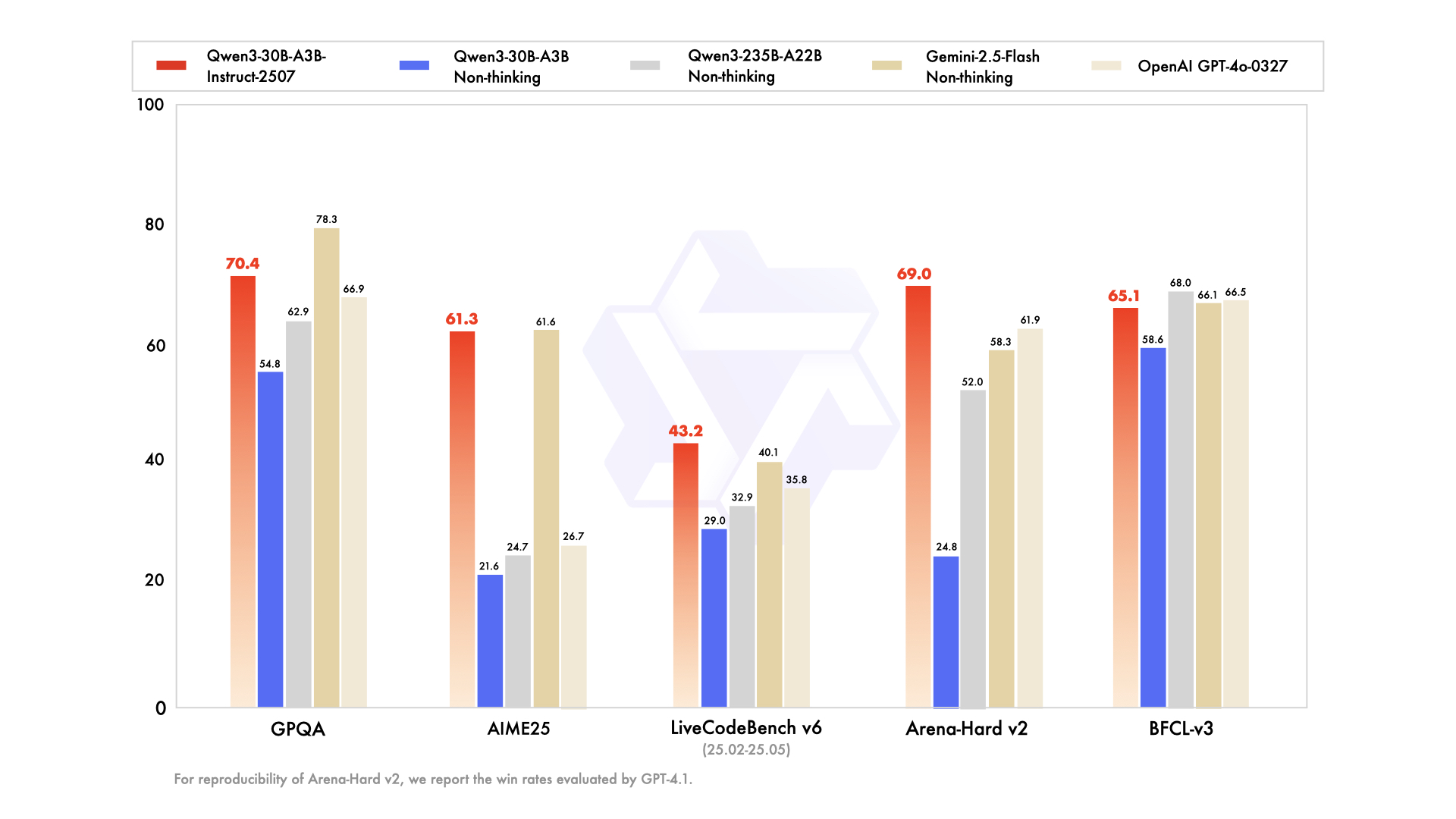
83 ## Performance
84
85 | | Deepseek-V3-0324 | GPT-4o-0327 | Gemini-2.5-Flash Non-Thinking | Qwen3-235B-A22B Non-Thinking | Qwen3-30B-A3B Non-Thinking | Qwen3-30B-A3B-Instruct-2507 |
86 |--- | --- | --- | --- | --- | --- | --- |
87 | **Knowledge** | | | | | | |
88 | MMLU-Pro | **81.2** | 79.8 | 81.1 | 75.2 | 69.1 | 78.4 |
89 | MMLU-Redux | 90.4 | **91.3** | 90.6 | 89.2 | 84.1 | 89.3 |
90 | GPQA | 68.4 | 66.9 | **78.3** | 62.9 | 54.8 | 70.4 |
91 | SuperGPQA | **57.3** | 51.0 | 54.6 | 48.2 | 42.2 | 53.4 |
92 | **Reasoning** | | | | | | |
93 | AIME25 | 46.6 | 26.7 | **61.6** | 24.7 | 21.6 | 61.3 |
94 | HMMT25 | 27.5 | 7.9 | **45.8** | 10.0 | 12.0 | 43.0 |
95 | ZebraLogic | 83.4 | 52.6 | 57.9 | 37.7 | 33.2 | **90.0** |
96 | LiveBench `20241125` | 66.9 | 63.7 | **69.1** | 62.5 | 59.4 | 69.0 |
97 | **Coding** | | | | | | |
98 | LiveCodeBench v6 (25.02-25.05) | **45.2** | 35.8 | 40.1 | 32.9 | 29.0 | 43.2 |
99 | MultiPL-E | 82.2 | 82.7 | 77.7 | 79.3 | 74.6 | **83.8** |
100 | Aider-Polyglot | 55.1 | 45.3 | 44.0 | **59.6** | 24.4 | 35.6 |
101 | **Alignment** | | | | | | |
102 | IFEval | 82.3 | 83.9 | 84.3 | 83.2 | 83.7 | **84.7** |
103 | Arena-Hard v2* | 45.6 | 61.9 | 58.3 | 52.0 | 24.8 | **69.0** |
104 | Creative Writing v3 | 81.6 | 84.9 | 84.6 | 80.4 | 68.1 | **86.0** |
105 | WritingBench | 74.5 | 75.5 | 80.5 | 77.0 | 72.2 | **85.5** |
106 | **Agent** | | | | | | |
107 | BFCL-v3 | 64.7 | 66.5 | 66.1 | **68.0** | 58.6 | 65.1 |
108 | TAU1-Retail | 49.6 | 60.3# | **65.2** | 65.2 | 38.3 | 59.1 |
109 | TAU1-Airline | 32.0 | 42.8# | **48.0** | 32.0 | 18.0 | 40.0 |
110 | TAU2-Retail | **71.1** | 66.7# | 64.3 | 64.9 | 31.6 | 57.0 |
111 | TAU2-Airline | 36.0 | 42.0# | **42.5** | 36.0 | 18.0 | 38.0 |
112 | TAU2-Telecom | **34.0** | 29.8# | 16.9 | 24.6 | 18.4 | 12.3 |
113 | **Multilingualism** | | | | | | |
114 | MultiIF | 66.5 | 70.4 | 69.4 | 70.2 | **70.8** | 67.9 |
115 | MMLU-ProX | 75.8 | 76.2 | **78.3** | 73.2 | 65.1 | 72.0 |
116 | INCLUDE | 80.1 | 82.1 | **83.8** | 75.6 | 67.8 | 71.9 |
117 | PolyMATH | 32.2 | 25.5 | 41.9 | 27.0 | 23.3 | **43.1** |
118
119 *: For reproducibility, we report the win rates evaluated by GPT-4.1.
120
121 \#: Results were generated using GPT-4o-`20241120`, as access to the native function calling API of GPT-4o-0327 was unavailable.
122
123
124 ## Quickstart
125
126 The code of Qwen3-MoE has been in the latest Hugging Face `transformers` and we advise you to use the latest version of `transformers`.
127
128 With `transformers<4.51.0`, you will encounter the following error:
129 ```
130 KeyError: 'qwen3_moe'
131 ```
132
133 The following contains a code snippet illustrating how to use the model generate content based on given inputs.
134 ```python
135 from transformers import AutoModelForCausalLM, AutoTokenizer
136
137 model_name = "Qwen/Qwen3-30B-A3B-Instruct-2507"
138
139 # load the tokenizer and the model
140 tokenizer = AutoTokenizer.from_pretrained(model_name)
141 model = AutoModelForCausalLM.from_pretrained(
142 model_name,
143 torch_dtype="auto",
144 device_map="auto"
145 )
146
147 # prepare the model input
148 prompt = "Give me a short introduction to large language model."
149 messages = [
150 {"role": "user", "content": prompt}
151 ]
152 text = tokenizer.apply_chat_template(
153 messages,
154 tokenize=False,
155 add_generation_prompt=True,
156 )
157 model_inputs = tokenizer([text], return_tensors="pt").to(model.device)
158
159 # conduct text completion
160 generated_ids = model.generate(
161 **model_inputs,
162 max_new_tokens=16384
163 )
164 output_ids = generated_ids[0][len(model_inputs.input_ids[0]):].tolist()
165
166 content = tokenizer.decode(output_ids, skip_special_tokens=True)
167
168 print("content:", content)
169 ```
170
171 For deployment, you can use `sglang>=0.4.6.post1` or `vllm>=0.8.5` or to create an OpenAI-compatible API endpoint:
172 - SGLang:
173 ```shell
174 python -m sglang.launch_server --model-path Qwen/Qwen3-30B-A3B-Instruct-2507 --context-length 262144
175 ```
176 - vLLM:
177 ```shell
178 vllm serve Qwen/Qwen3-30B-A3B-Instruct-2507 --max-model-len 262144
179 ```
180
181 **Note: If you encounter out-of-memory (OOM) issues, consider reducing the context length to a shorter value, such as `32,768`.**
182
183 For local use, applications such as Ollama, LMStudio, MLX-LM, llama.cpp, and KTransformers have also supported Qwen3.
184
185 ## Agentic Use
186
187 Qwen3 excels in tool calling capabilities. We recommend using [Qwen-Agent](https://github.com/QwenLM/Qwen-Agent) to make the best use of agentic ability of Qwen3. Qwen-Agent encapsulates tool-calling templates and tool-calling parsers internally, greatly reducing coding complexity.
188
189 To define the available tools, you can use the MCP configuration file, use the integrated tool of Qwen-Agent, or integrate other tools by yourself.
190 ```python
191 from qwen_agent.agents import Assistant
192
193 # Define LLM
194 llm_cfg = {
195 'model': 'Qwen3-30B-A3B-Instruct-2507',
196
197 # Use a custom endpoint compatible with OpenAI API:
198 'model_server': 'http://localhost:8000/v1', # api_base
199 'api_key': 'EMPTY',
200 }
201
202 # Define Tools
203 tools = [
204 {'mcpServers': { # You can specify the MCP configuration file
205 'time': {
206 'command': 'uvx',
207 'args': ['mcp-server-time', '--local-timezone=Asia/Shanghai']
208 },
209 "fetch": {
210 "command": "uvx",
211 "args": ["mcp-server-fetch"]
212 }
213 }
214 },
215 'code_interpreter', # Built-in tools
216 ]
217
218 # Define Agent
219 bot = Assistant(llm=llm_cfg, function_list=tools)
220
221 # Streaming generation
222 messages = [{'role': 'user', 'content': 'https://qwenlm.github.io/blog/ Introduce the latest developments of Qwen'}]
223 for responses in bot.run(messages=messages):
224 pass
225 print(responses)
226 ```
227
228 ## Best Practices
229
230 To achieve optimal performance, we recommend the following settings:
231
232 1. **Sampling Parameters**:
233 - We suggest using `Temperature=0.7`, `TopP=0.8`, `TopK=20`, and `MinP=0`.
234 - For supported frameworks, you can adjust the `presence_penalty` parameter between 0 and 2 to reduce endless repetitions. However, using a higher value may occasionally result in language mixing and a slight decrease in model performance.
235
236 2. **Adequate Output Length**: We recommend using an output length of 16,384 tokens for most queries, which is adequate for instruct models.
237
238 3. **Standardize Output Format**: We recommend using prompts to standardize model outputs when benchmarking.
239 - **Math Problems**: Include "Please reason step by step, and put your final answer within \boxed{}." in the prompt.
240 - **Multiple-Choice Questions**: Add the following JSON structure to the prompt to standardize responses: "Please show your choice in the `answer` field with only the choice letter, e.g., `"answer": "C"`."
241
242 ### Citation
243
244 If you find our work helpful, feel free to give us a cite.
245
246 ```
247 @misc{qwen3technicalreport,
248 title={Qwen3 Technical Report},
249 author={Qwen Team},
250 year={2025},
251 eprint={2505.09388},
252 archivePrefix={arXiv},
253 primaryClass={cs.CL},
254 url={https://arxiv.org/abs/2505.09388},
255 }
256 ```