aienux
Aienux, the AienOS kernel: boot, scheduling, IPC and capability boundaries. Pre-alpha; host, emulator and physical evidence are labelled separately.
Brought by drakestapleton
aienux / vendor / itoa / src / lib.rs
| 1 | //! [![github]](https://github.com/dtolnay/itoa) [![crates-io]](https://crates.io/crates/itoa) [![docs-rs]](https://docs.rs/itoa) |
| 2 | //! |
| 3 | //! [github]: https://img.shields.io/badge/github-8da0cb?style=for-the-badge&labelColor=555555&logo=github |
| 4 | //! [crates-io]: https://img.shields.io/badge/crates.io-fc8d62?style=for-the-badge&labelColor=555555&logo=rust |
| 5 | //! [docs-rs]: https://img.shields.io/badge/docs.rs-66c2a5?style=for-the-badge&labelColor=555555&logo=docs.rs |
| 6 | //! |
| 7 | //! <br> |
| 8 | //! |
| 9 | //! This crate provides a fast conversion of integer primitives to decimal |
| 10 | //! strings. The implementation comes straight from [libcore] but avoids the |
| 11 | //! performance penalty of going through [`core::fmt::Formatter`]. |
| 12 | //! |
| 13 | //! See also [`zmij`] for printing floating point primitives. |
| 14 | //! |
| 15 | //! [libcore]: https://github.com/rust-lang/rust/blob/1.92.0/library/core/src/fmt/num.rs#L190-L253 |
| 16 | //! [`zmij`]: https://github.com/dtolnay/zmij |
| 17 | //! |
| 18 | //! # Example |
| 19 | //! |
| 20 | //! ``` |
| 21 | //! fn main() { |
| 22 | //! let mut buffer = itoa::Buffer::new(); |
| 23 | //! let printed = buffer.format(128u64); |
| 24 | //! assert_eq!(printed, "128"); |
| 25 | //! } |
| 26 | //! ``` |
| 27 | //! |
| 28 | //! # Performance |
| 29 | //! |
| 30 | //! The [itoa-benchmark] compares this library and other Rust integer formatting |
| 31 | //! implementations across a range of integer sizes. The vertical axis in this |
| 32 | //! chart shows nanoseconds taken by a single execution of |
| 33 | //! `itoa::Buffer::new().format(value)` so a lower result indicates a faster |
| 34 | //! library. |
| 35 | //! |
| 36 | //! [itoa-benchmark]: https://github.com/dtolnay/itoa-benchmark |
| 37 | //! |
| 38 | //! 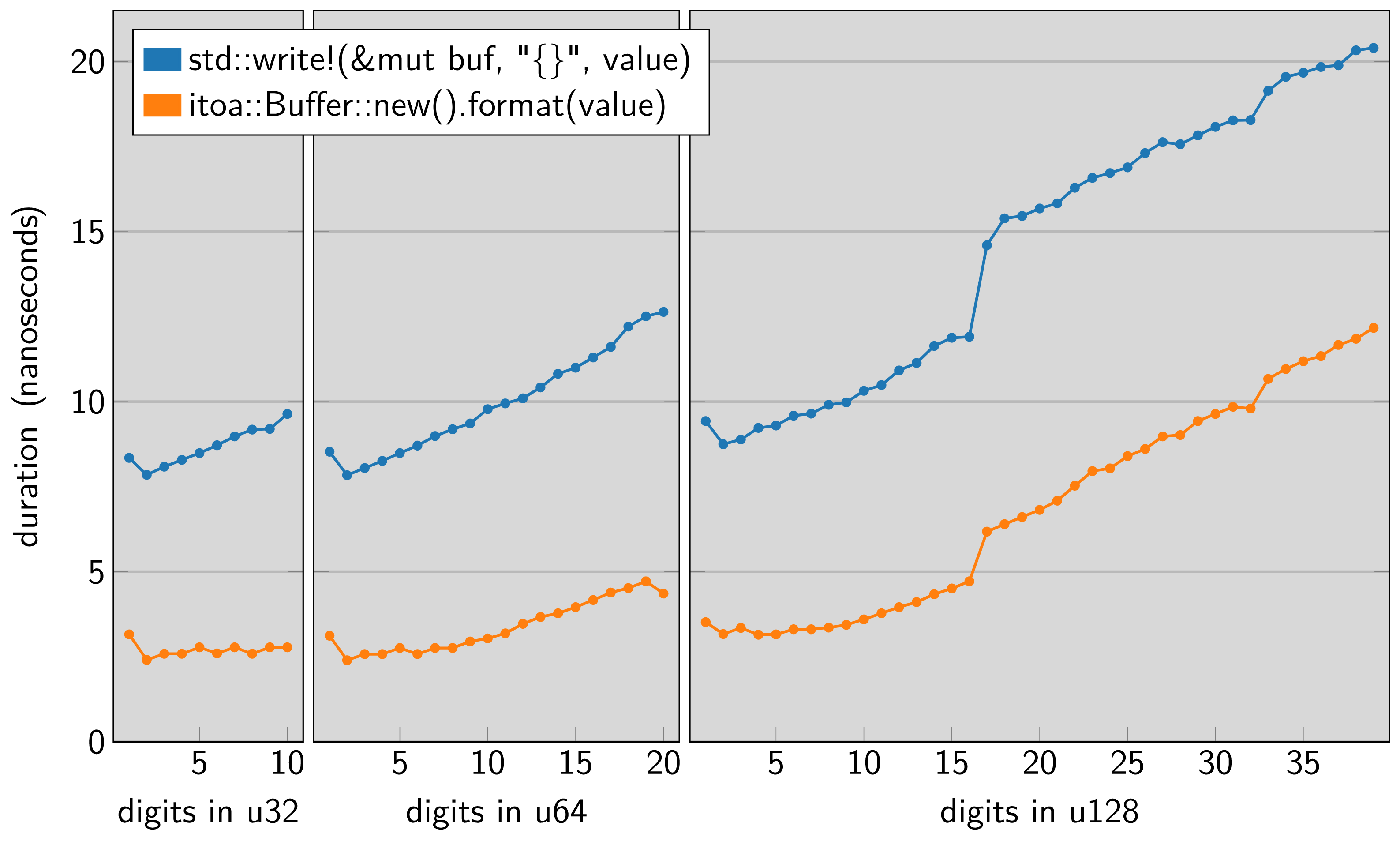 |
| 39 | |
| 40 | #![doc(html_root_url = "https://docs.rs/itoa/1.0.18")] |
| 41 | #![no_std] |
| 42 | #![allow( |
| 43 | clippy::cast_lossless, |
| 44 | clippy::cast_possible_truncation, |
| 45 | clippy::cast_sign_loss, |
| 46 | clippy::expl_impl_clone_on_copy, |
| 47 | clippy::identity_op, |
| 48 | clippy::items_after_statements, |
| 49 | clippy::must_use_candidate, |
| 50 | clippy::needless_doctest_main, |
| 51 | clippy::unreadable_literal |
| 52 | )] |
| 53 | |
| 54 | mod u128_ext; |
| 55 | |
| 56 | use core::hint; |
| 57 | use core::mem::{self, MaybeUninit}; |
| 58 | use core::str; |
| 59 | #[cfg(feature = "no-panic")] |
| 60 | use no_panic::no_panic; |
| 61 | |
| 62 | /// A correctly sized stack allocation for the formatted integer to be written |
| 63 | /// into. |
| 64 | /// |
| 65 | /// # Example |
| 66 | /// |
| 67 | /// ``` |
| 68 | /// let mut buffer = itoa::Buffer::new(); |
| 69 | /// let printed = buffer.format(1234); |
| 70 | /// assert_eq!(printed, "1234"); |
| 71 | /// ``` |
| 72 | pub struct Buffer { |
| 73 | bytes: [MaybeUninit<u8>; i128::MAX_STR_LEN], |
| 74 | } |
| 75 | |
| 76 | impl Default for Buffer { |
| 77 | #[inline] |
| 78 | fn default() -> Buffer { |
| 79 | Buffer::new() |
| 80 | } |
| 81 | } |
| 82 | |
| 83 | impl Copy for Buffer {} |
| 84 | |
| 85 | #[allow(clippy::non_canonical_clone_impl)] |
| 86 | impl Clone for Buffer { |
| 87 | #[inline] |
| 88 | fn clone(&self) -> Self { |
| 89 | Buffer::new() |
| 90 | } |
| 91 | } |
| 92 | |
| 93 | impl Buffer { |
| 94 | /// This is a cheap operation; you don't need to worry about reusing buffers |
| 95 | /// for efficiency. |
| 96 | #[inline] |
| 97 | #[cfg_attr(feature = "no-panic", no_panic)] |
| 98 | pub fn new() -> Buffer { |
| 99 | let bytes = [MaybeUninit::<u8>::uninit(); i128::MAX_STR_LEN]; |
| 100 | Buffer { bytes } |
| 101 | } |
| 102 | |
| 103 | /// Print an integer into this buffer and return a reference to its string |
| 104 | /// representation within the buffer. |
| 105 | #[cfg_attr(feature = "no-panic", no_panic)] |
| 106 | pub fn format<I: Integer>(&mut self, i: I) -> &str { |
| 107 | let buf_ptr = self.bytes.as_mut_ptr().cast::<I::Buffer>(); |
| 108 | let string = i.write(unsafe { &mut *buf_ptr }); |
| 109 | if string.len() > I::MAX_STR_LEN { |
| 110 | unsafe { hint::unreachable_unchecked() }; |
| 111 | } |
| 112 | string |
| 113 | } |
| 114 | } |
| 115 | |
| 116 | /// An integer that can be written into an [`itoa::Buffer`][Buffer]. |
| 117 | /// |
| 118 | /// This trait is sealed and cannot be implemented for types outside of itoa. |
| 119 | pub trait Integer: private::Sealed { |
| 120 | /// The maximum length of string that formatting an integer of this type can |
| 121 | /// produce on the current target platform. |
| 122 | const MAX_STR_LEN: usize; |
| 123 | } |
| 124 | |
| 125 | // Seal to prevent downstream implementations of the Integer trait. |
| 126 | mod private { |
| 127 | #[doc(hidden)] |
| 128 | pub trait Sealed: Copy { |
| 129 | #[doc(hidden)] |
| 130 | type Buffer: 'static; |
| 131 | fn write(self, buf: &mut Self::Buffer) -> &str; |
| 132 | } |
| 133 | } |
| 134 | |
| 135 | macro_rules! impl_Integer { |
| 136 | ($Signed:ident, $Unsigned:ident) => { |
| 137 | const _: () = { |
| 138 | assert!($Signed::MIN < 0, "need signed"); |
| 139 | assert!($Unsigned::MIN == 0, "need unsigned"); |
| 140 | assert!($Signed::BITS == $Unsigned::BITS, "need counterparts"); |
| 141 | }; |
| 142 | |
| 143 | impl Integer for $Unsigned { |
| 144 | const MAX_STR_LEN: usize = $Unsigned::MAX.ilog10() as usize + 1; |
| 145 | } |
| 146 | |
| 147 | impl private::Sealed for $Unsigned { |
| 148 | type Buffer = [MaybeUninit<u8>; Self::MAX_STR_LEN]; |
| 149 | |
| 150 | #[inline] |
| 151 | #[cfg_attr(feature = "no-panic", no_panic)] |
| 152 | fn write(self, buf: &mut Self::Buffer) -> &str { |
| 153 | let offset = Unsigned::fmt(self, buf); |
| 154 | // SAFETY: Starting from `offset`, all elements of the slice have been set. |
| 155 | unsafe { slice_buffer_to_str(buf, offset) } |
| 156 | } |
| 157 | } |
| 158 | |
| 159 | impl Integer for $Signed { |
| 160 | const MAX_STR_LEN: usize = $Signed::MAX.ilog10() as usize + 2; |
| 161 | } |
| 162 | |
| 163 | impl private::Sealed for $Signed { |
| 164 | type Buffer = [MaybeUninit<u8>; Self::MAX_STR_LEN]; |
| 165 | |
| 166 | #[inline] |
| 167 | #[cfg_attr(feature = "no-panic", no_panic)] |
| 168 | fn write(self, buf: &mut Self::Buffer) -> &str { |
| 169 | let mut offset = Self::MAX_STR_LEN - $Unsigned::MAX_STR_LEN; |
| 170 | offset += Unsigned::fmt( |
| 171 | self.unsigned_abs(), |
| 172 | (&mut buf[offset..]).try_into().unwrap(), |
| 173 | ); |
| 174 | if self < 0 { |
| 175 | offset -= 1; |
| 176 | buf[offset].write(b'-'); |
| 177 | } |
| 178 | // SAFETY: Starting from `offset`, all elements of the slice have been set. |
| 179 | unsafe { slice_buffer_to_str(buf, offset) } |
| 180 | } |
| 181 | } |
| 182 | }; |
| 183 | } |
| 184 | |
| 185 | impl_Integer!(i8, u8); |
| 186 | impl_Integer!(i16, u16); |
| 187 | impl_Integer!(i32, u32); |
| 188 | impl_Integer!(i64, u64); |
| 189 | impl_Integer!(i128, u128); |
| 190 | |
| 191 | macro_rules! impl_Integer_size { |
| 192 | ($t:ty as $primitive:ident #[cfg(target_pointer_width = $width:literal)]) => { |
| 193 | #[cfg(target_pointer_width = $width)] |
| 194 | impl Integer for $t { |
| 195 | const MAX_STR_LEN: usize = <$primitive as Integer>::MAX_STR_LEN; |
| 196 | } |
| 197 | |
| 198 | #[cfg(target_pointer_width = $width)] |
| 199 | impl private::Sealed for $t { |
| 200 | type Buffer = <$primitive as private::Sealed>::Buffer; |
| 201 | |
| 202 | #[inline] |
| 203 | #[cfg_attr(feature = "no-panic", no_panic)] |
| 204 | fn write(self, buf: &mut Self::Buffer) -> &str { |
| 205 | (self as $primitive).write(buf) |
| 206 | } |
| 207 | } |
| 208 | }; |
| 209 | } |
| 210 | |
| 211 | impl_Integer_size!(isize as i16 #[cfg(target_pointer_width = "16")]); |
| 212 | impl_Integer_size!(usize as u16 #[cfg(target_pointer_width = "16")]); |
| 213 | impl_Integer_size!(isize as i32 #[cfg(target_pointer_width = "32")]); |
| 214 | impl_Integer_size!(usize as u32 #[cfg(target_pointer_width = "32")]); |
| 215 | impl_Integer_size!(isize as i64 #[cfg(target_pointer_width = "64")]); |
| 216 | impl_Integer_size!(usize as u64 #[cfg(target_pointer_width = "64")]); |
| 217 | |
| 218 | #[repr(C, align(2))] |
| 219 | struct DecimalPairs([u8; 200]); |
| 220 | |
| 221 | // The string of all two-digit numbers in range 00..99 is used as a lookup table. |
| 222 | static DECIMAL_PAIRS: DecimalPairs = DecimalPairs( |
| 223 | *b"0001020304050607080910111213141516171819\ |
| 224 | 2021222324252627282930313233343536373839\ |
| 225 | 4041424344454647484950515253545556575859\ |
| 226 | 6061626364656667686970717273747576777879\ |
| 227 | 8081828384858687888990919293949596979899", |
| 228 | ); |
| 229 | |
| 230 | // Returns {value / 100, value % 100} correct for values of up to 4 digits. |
| 231 | fn divmod100(value: u32) -> (u32, u32) { |
| 232 | debug_assert!(value < 10_000); |
| 233 | const EXP: u32 = 19; // 19 is faster or equal to 12 even for 3 digits. |
| 234 | const SIG: u32 = (1 << EXP) / 100 + 1; |
| 235 | let div = (value * SIG) >> EXP; // value / 100 |
| 236 | (div, value - div * 100) |
| 237 | } |
| 238 | |
| 239 | /// This function converts a slice of ascii characters into a `&str` starting |
| 240 | /// from `offset`. |
| 241 | /// |
| 242 | /// # Safety |
| 243 | /// |
| 244 | /// `buf` content starting from `offset` index MUST BE initialized and MUST BE |
| 245 | /// ascii characters. |
| 246 | #[cfg_attr(feature = "no-panic", no_panic)] |
| 247 | unsafe fn slice_buffer_to_str(buf: &[MaybeUninit<u8>], offset: usize) -> &str { |
| 248 | // SAFETY: `offset` is always included between 0 and `buf`'s length. |
| 249 | let written = unsafe { buf.get_unchecked(offset..) }; |
| 250 | // SAFETY: (`assume_init_ref`) All buf content since offset is set. |
| 251 | // SAFETY: (`from_utf8_unchecked`) Writes use ASCII from the lookup table exclusively. |
| 252 | unsafe { str::from_utf8_unchecked(&*(written as *const [MaybeUninit<u8>] as *const [u8])) } |
| 253 | } |
| 254 | |
| 255 | trait Unsigned: Integer { |
| 256 | fn fmt(self, buf: &mut Self::Buffer) -> usize; |
| 257 | } |
| 258 | |
| 259 | macro_rules! impl_Unsigned { |
| 260 | ($Unsigned:ident) => { |
| 261 | impl Unsigned for $Unsigned { |
| 262 | #[cfg_attr(feature = "no-panic", no_panic)] |
| 263 | fn fmt(self, buf: &mut Self::Buffer) -> usize { |
| 264 | // Count the number of bytes in buf that are not initialized. |
| 265 | let mut offset = buf.len(); |
| 266 | // Consume the least-significant decimals from a working copy. |
| 267 | let mut remain = self; |
| 268 | |
| 269 | // Format per four digits from the lookup table. |
| 270 | // Four digits need a 16-bit $Unsigned or wider. |
| 271 | while mem::size_of::<Self>() > 1 |
| 272 | && remain |
| 273 | > 999 |
| 274 | .try_into() |
| 275 | .expect("branch is not hit for types that cannot fit 999 (u8)") |
| 276 | { |
| 277 | offset -= 4; |
| 278 | |
| 279 | // pull two pairs |
| 280 | let scale: Self = 1_00_00 |
| 281 | .try_into() |
| 282 | .expect("branch is not hit for types that cannot fit 1E4 (u8)"); |
| 283 | let quad = remain % scale; |
| 284 | remain /= scale; |
| 285 | let (pair1, pair2) = divmod100(quad as u32); |
| 286 | unsafe { |
| 287 | buf[offset + 0] |
| 288 | .write(*DECIMAL_PAIRS.0.get_unchecked(pair1 as usize * 2 + 0)); |
| 289 | buf[offset + 1] |
| 290 | .write(*DECIMAL_PAIRS.0.get_unchecked(pair1 as usize * 2 + 1)); |
| 291 | buf[offset + 2] |
| 292 | .write(*DECIMAL_PAIRS.0.get_unchecked(pair2 as usize * 2 + 0)); |
| 293 | buf[offset + 3] |
| 294 | .write(*DECIMAL_PAIRS.0.get_unchecked(pair2 as usize * 2 + 1)); |
| 295 | } |
| 296 | } |
| 297 | |
| 298 | // Format per two digits from the lookup table. |
| 299 | if remain > 9 { |
| 300 | offset -= 2; |
| 301 | |
| 302 | let (last, pair) = divmod100(remain as u32); |
| 303 | remain = last as Self; |
| 304 | unsafe { |
| 305 | buf[offset + 0] |
| 306 | .write(*DECIMAL_PAIRS.0.get_unchecked(pair as usize * 2 + 0)); |
| 307 | buf[offset + 1] |
| 308 | .write(*DECIMAL_PAIRS.0.get_unchecked(pair as usize * 2 + 1)); |
| 309 | } |
| 310 | } |
| 311 | |
| 312 | // Format the last remaining digit, if any. |
| 313 | if remain != 0 || self == 0 { |
| 314 | offset -= 1; |
| 315 | |
| 316 | // Either the compiler sees that remain < 10, or it prevents |
| 317 | // a boundary check up next. |
| 318 | let last = remain as u8 & 15; |
| 319 | buf[offset].write(b'0' + last); |
| 320 | // not used: remain = 0; |
| 321 | } |
| 322 | |
| 323 | offset |
| 324 | } |
| 325 | } |
| 326 | }; |
| 327 | } |
| 328 | |
| 329 | impl_Unsigned!(u8); |
| 330 | impl_Unsigned!(u16); |
| 331 | impl_Unsigned!(u32); |
| 332 | impl_Unsigned!(u64); |
| 333 | |
| 334 | impl Unsigned for u128 { |
| 335 | #[cfg_attr(feature = "no-panic", no_panic)] |
| 336 | fn fmt(self, buf: &mut Self::Buffer) -> usize { |
| 337 | // Optimize common-case zero, which would also need special treatment due to |
| 338 | // its "leading" zero. |
| 339 | if self == 0 { |
| 340 | let offset = buf.len() - 1; |
| 341 | buf[offset].write(b'0'); |
| 342 | return offset; |
| 343 | } |
| 344 | // Take the 16 least-significant decimals. |
| 345 | let (quot_1e16, mod_1e16) = div_rem_1e16(self); |
| 346 | let (mut remain, mut offset) = if quot_1e16 == 0 { |
| 347 | (mod_1e16, u128::MAX_STR_LEN) |
| 348 | } else { |
| 349 | // Write digits at buf[23..39]. |
| 350 | enc_16lsd::<{ u128::MAX_STR_LEN - 16 }>(buf, mod_1e16); |
| 351 | |
| 352 | // Take another 16 decimals. |
| 353 | let (quot2, mod2) = div_rem_1e16(quot_1e16); |
| 354 | if quot2 == 0 { |
| 355 | (mod2, u128::MAX_STR_LEN - 16) |
| 356 | } else { |
| 357 | // Write digits at buf[7..23]. |
| 358 | enc_16lsd::<{ u128::MAX_STR_LEN - 32 }>(buf, mod2); |
| 359 | // Quot2 has at most 7 decimals remaining after two 1e16 divisions. |
| 360 | (quot2 as u64, u128::MAX_STR_LEN - 32) |
| 361 | } |
| 362 | }; |
| 363 | |
| 364 | // Format per four digits from the lookup table. |
| 365 | while remain > 999 { |
| 366 | offset -= 4; |
| 367 | |
| 368 | // pull two pairs |
| 369 | let quad = remain % 1_00_00; |
| 370 | remain /= 1_00_00; |
| 371 | let (pair1, pair2) = divmod100(quad as u32); |
| 372 | unsafe { |
| 373 | buf[offset + 0].write(*DECIMAL_PAIRS.0.get_unchecked(pair1 as usize * 2 + 0)); |
| 374 | buf[offset + 1].write(*DECIMAL_PAIRS.0.get_unchecked(pair1 as usize * 2 + 1)); |
| 375 | buf[offset + 2].write(*DECIMAL_PAIRS.0.get_unchecked(pair2 as usize * 2 + 0)); |
| 376 | buf[offset + 3].write(*DECIMAL_PAIRS.0.get_unchecked(pair2 as usize * 2 + 1)); |
| 377 | } |
| 378 | } |
| 379 | |
| 380 | // Format per two digits from the lookup table. |
| 381 | if remain > 9 { |
| 382 | offset -= 2; |
| 383 | |
| 384 | let (last, pair) = divmod100(remain as u32); |
| 385 | remain = last as u64; |
| 386 | unsafe { |
| 387 | buf[offset + 0].write(*DECIMAL_PAIRS.0.get_unchecked(pair as usize * 2 + 0)); |
| 388 | buf[offset + 1].write(*DECIMAL_PAIRS.0.get_unchecked(pair as usize * 2 + 1)); |
| 389 | } |
| 390 | } |
| 391 | |
| 392 | // Format the last remaining digit, if any. |
| 393 | if remain != 0 { |
| 394 | offset -= 1; |
| 395 | |
| 396 | // Either the compiler sees that remain < 10, or it prevents |
| 397 | // a boundary check up next. |
| 398 | let last = remain as u8 & 15; |
| 399 | buf[offset].write(b'0' + last); |
| 400 | // not used: remain = 0; |
| 401 | } |
| 402 | offset |
| 403 | } |
| 404 | } |
| 405 | |
| 406 | // Encodes the 16 least-significant decimals of n into `buf[OFFSET..OFFSET + 16]`. |
| 407 | #[cfg_attr(feature = "no-panic", no_panic)] |
| 408 | fn enc_16lsd<const OFFSET: usize>(buf: &mut [MaybeUninit<u8>], n: u64) { |
| 409 | // Consume the least-significant decimals from a working copy. |
| 410 | let mut remain = n; |
| 411 | |
| 412 | // Format per four digits from the lookup table. |
| 413 | for quad_index in (1..4).rev() { |
| 414 | // pull two pairs |
| 415 | let quad = remain % 1_00_00; |
| 416 | remain /= 1_00_00; |
| 417 | let (pair1, pair2) = divmod100(quad as u32); |
| 418 | unsafe { |
| 419 | buf[quad_index * 4 + OFFSET + 0] |
| 420 | .write(*DECIMAL_PAIRS.0.get_unchecked(pair1 as usize * 2 + 0)); |
| 421 | buf[quad_index * 4 + OFFSET + 1] |
| 422 | .write(*DECIMAL_PAIRS.0.get_unchecked(pair1 as usize * 2 + 1)); |
| 423 | buf[quad_index * 4 + OFFSET + 2] |
| 424 | .write(*DECIMAL_PAIRS.0.get_unchecked(pair2 as usize * 2 + 0)); |
| 425 | buf[quad_index * 4 + OFFSET + 3] |
| 426 | .write(*DECIMAL_PAIRS.0.get_unchecked(pair2 as usize * 2 + 1)); |
| 427 | } |
| 428 | } |
| 429 | |
| 430 | // final two pairs |
| 431 | let (pair1, pair2) = divmod100(remain as u32); |
| 432 | unsafe { |
| 433 | buf[OFFSET + 0].write(*DECIMAL_PAIRS.0.get_unchecked(pair1 as usize * 2 + 0)); |
| 434 | buf[OFFSET + 1].write(*DECIMAL_PAIRS.0.get_unchecked(pair1 as usize * 2 + 1)); |
| 435 | buf[OFFSET + 2].write(*DECIMAL_PAIRS.0.get_unchecked(pair2 as usize * 2 + 0)); |
| 436 | buf[OFFSET + 3].write(*DECIMAL_PAIRS.0.get_unchecked(pair2 as usize * 2 + 1)); |
| 437 | } |
| 438 | } |
| 439 | |
| 440 | // Euclidean division plus remainder with constant 1E16 basically consumes 16 |
| 441 | // decimals from n. |
| 442 | // |
| 443 | // The integer division algorithm is based on the following paper: |
| 444 | // |
| 445 | // T. Granlund and P. Montgomery, “Division by Invariant Integers Using Multiplication” |
| 446 | // in Proc. of the SIGPLAN94 Conference on Programming Language Design and |
| 447 | // Implementation, 1994, pp. 61–72 |
| 448 | // |
| 449 | #[cfg_attr(feature = "no-panic", no_panic)] |
| 450 | fn div_rem_1e16(n: u128) -> (u128, u64) { |
| 451 | const D: u128 = 1_0000_0000_0000_0000; |
| 452 | // The check inlines well with the caller flow. |
| 453 | if n < D { |
| 454 | return (0, n as u64); |
| 455 | } |
| 456 | |
| 457 | // These constant values are computed with the CHOOSE_MULTIPLIER procedure |
| 458 | // from the Granlund & Montgomery paper, using N=128, prec=128 and d=1E16. |
| 459 | const M_HIGH: u128 = 76624777043294442917917351357515459181; |
| 460 | const SH_POST: u8 = 51; |
| 461 | |
| 462 | // n.widening_mul(M_HIGH).1 >> SH_POST |
| 463 | let quot = u128_ext::mulhi(n, M_HIGH) >> SH_POST; |
| 464 | let rem = n - quot * D; |
| 465 | (quot, rem as u64) |
| 466 | } |